Tuesday, October 11, 2005

Follow the money: part 2

15 months ago, I explained why the Japanese economy wasn't worth getting excited about.

For the same reasons, it still isn't.

However, given Japan's recent upturn, it may be tempting to at least start getting excited.

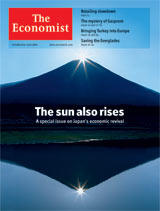
This week, The Economist succumbed to just that temptation.

Just like the magazine, I didn't buy it.

Did you?

************************************
One key piece of economic data that I look to for any sign of confidence in an economy is its money supply (the first column on the left shows the growth rate tending lower in 2005).

This represents the blood flowing through the veins.

If it doesn't circulate well, there's something wrong.

Judging by Japan's money supply, there's still something wrong with their economy.

Really?

It's only when Japanese individuals and companies are ready to use money, intead of putting it away for a rainy day, that brighter days will come.

Unfortunately, this is a self-fulfilling prophecy: the less confidence Japanese have in their economy, the worse it will continue to perform.

************************************

The recent strategy of Japan's central bank has been much like its over-prescribing doctors: pumping the patient (economy) with excessive amounts of drugs (liquidity).

While Japan has been drugged up with money, China has raced ahead and now poses a greater threat than ever.

Japanese firms are right to be cautious about investing their money. Only when that money gets put to use will Japan be ready to take on China, Korea and the rest of the world.

Until then, the light at the end of the tunnel will remain the headlights of China and others heading straight for it.

Wednesday, September 21, 2005

Why economists shouldn't forecast

Hindsight provides an opportunity to learn from our mistakes.

Ideally, we learn enough about our mistakes never to repeat them again.

Economists who make forecasts disagree: The past is in the past. The future is different and uncertain. It's hard to disagree with that. After all, economists know what they're doing, right?

Not quite.

***********************

Over a year ago I wrote about the assumptions economists need to make. The International Monetary Fund has just published its World Economic Outlook, with it's regular section on assumptions (pdf, p.viii).

In 2004, the IMF made the following assumptions about oil prices:

"... the average price of oil will be $30.00 a barrel in 2004 and $27.00 a barrel in 2005, and remain unchanged in real terms over the medium term." (viii)

These levels were clearly way off course, as were their forecasts for economic growth.

In 2005, they now assume the following for crude oil prices:

"... the average price of oil will be $54.23 a barrel in 2005 and $61.75 a barrel in 2006 (viii)

Naturally, these forecasts are wrong as are their forecasts for economic growth.

***********************

The moral of this story?

(1) Always consider the assumptions behind an economist's forecast;
(2) Never trust an economist's forecast;
(3) Economists shouldn't make forecasts.

and

(4) Your forecast is as good as an economist's!

Sunday, September 18, 2005

A real dilemma

If you're one of those people who expects the U.S. Federal Reserve to stop raising interest rates next week then you probably don't look at enough charts.

If you were to look at the charts the Fed looks at then you would understand why to stop raising interest rates now would defeat the purpose of the past 12 months of rate hikes.

One piece of data the Fed takes very seriously is the real interest rate; the interest earned on overnight deposits after taking account of inflation (i.e. higher inflation means lower real interest).


Going up

What the chart shows is that real interest rates are currently zero. Putting $1 in your bank account today will earn no interest in real terms. Your dollar today buys you less tomorrow. That's not going to help anyone, including those who survived the hurricane.

What the Fed is aiming towards is a neutral real interest rate. Judging from the past that means we should expect at least another 2% of interest rate hikes by the Fed (measured, not stirred).

****************

Nothing can stand in the way of the Fed on a mission, not even a hurricane. When the time is right, interest rates will stop going higher. If history is anything to go by, that usually means they're ready to head in the opposite direction.

Sunday, August 07, 2005

Conundrum is Greenspan's legacy

Ben Bernanke sure has his work cut out for him.

Once he replaces Alan Greenspan next year, it's uphill all the way. Or should I say downhill...

Until now the U.S. Federal Reserve has been raising interest rates in an attempt to regain 'neutral' ground.

Near-zero interest rates were a recipe for disaster (i.e. Japan) so there was only one way interest could go.

Unfortunately, they haven't gone there quick enough.

**********************

Under Alan Greenspan's tentative guidance, the Fed looks like a driver lost in the dark. It knows it has somewhere to go, but it doesn't know exactly how to get there. So it takes it one small step at a time.

One problem with this is the ferrari behind (the bond market) is in a hurry to get where it wants to go!

The Fed is supposed to act as the "guiding light" for the bond market, dictating the future trend of interest rates.

Lately, the Fed has been a poor guide; the ferrari is ready to go it alone.

**********************

It's important not to forget how far the Fed has come.

As U.S. politicians continuously remind the public, interest rates are still at a 40-year low. And they got there pretty fast.


The black line indicates the Federal Reserve's overnight interest rate. The red bars are the interest rates on 10-year Treasuries. The Fed sure seemed to know where it was going 2 years ago!

When the Fed set out in a new direction at the end of 2004, the reasons weren't clearly laid out. The only clear fact was that interest rates were too low. The light, it assured the market, was at the end of the tunnel.

The ferrari didn't buy it.

Over the past year the Fed has lost credibility with the public and with the market (something that can only be earned through transparency , a point I made before the Fed started raising interest rates).

The market continues to buy bonds and the public continues to borrow money and purchase homes. The Fed should take a lot of credit for this (no pun intended).

**********************

When Alan Greenspan labelled the continuted fall in bond market yields this year a conundrum, it was like a driver scambling to find his current place on the map.

Unfortunately, it's too late for him to do anything about it, other than just vent.

With Bernanke at the wheel, the Fed may regain some credibility with the market and perhaps start leading the way.

Thursday, July 07, 2005

Do you feel safe yet?

It takes a human tragedy to make people realize just how vulnerable they are.

It takes a human tragedy for elected officials to reveal to the public this vulnerability.

New York Mayor, Mike Bloomberg, explained this morning how security measures have been "stepped up" in the subways, on the railways and at the ports in response to the bombings in London.

It doesn't seem the safest way to proceed if, in reaction to an attack that had no warning, that temporary measures are taken, aimed at improving national security. Surely we should have been at this state of preparedness all along?

This raises the question of just how prepared are we for another terrorist attack.

The answer is, it depends on what our elected officials are doing about it!

Today's tragedy helped to reveal just how vulnerable we are, thanks to the insufficient measures being taken by the people we elected for exactly that purpose!

** Afterthought **

I'm not the only one who lacks faith in the government's ability to prevent another terrorist attack. It's the stock market too. The U.S. stock market, and hence the global stock market, has learnt to live with the fact that another attack is coming and it won't be prevented, just reacted to.

Thursday, April 21, 2005

Alan Greenspan raised interest rates today. Did you notice?

Talk is cheap, right?

Not when the chairman of the Federal Reserve is talking.

If he's concerned then financial markets are concerned.

If markets are concerned, then you pay the price.


What did I say?

This morning, Alan Greenspan told congress:

"The federal budget is on an unsustainable path, in which large deficits result in rising interest rates."

So, "unless major deficit-reducing actions are taken" interest rates are more likely to go up than down.

Investors got nervous, thinking this might actually signal higher interest rates (since the person talking sets the target for the overnight interest rate). They sold bonds, pushing yields higher.

As I have discussed before the bond market is what essentially sets mortgage rates. If bond yields go up then your mortgage bill goes higher too.

****************************

It's important to remember that for policymakers, words are just as important as actions. Anything they say can be taken to imply something they may do.

Markets are always thinking about the future.

If you think like the market thinks, you can avoid getting hurt by it every single day.

Saturday, April 09, 2005

It's the stupid Economy!

It's very easy to criticize other people.

It's extremely easy to criticize economists.

These dismal scientists are given the thankless task by government to solve problems for which there are a number of different solutions, each with different costs associated with them.

Every solution will come with a cost.

No pain, no gain.

***************************

Some economists including, Friedrich August von Hayek , believe that government is the problem.

This is a very convincing argument given the history of evidence stacked against government policies over the recent past.

It seems as if every time the government tries to fix a problem they create another, larger problem in the process.

***************************

Of course, different views on any subject represent different parts of the political spectrum, so none will provide the kind of balanced judgement that might convince everyone.

In the current political system, it is only the majority of the voting public that needs to be convinced (every 4 years) in order to choose between (usually 2) competing (and often extreme) alternatives.

Tuesday, March 22, 2005

The dollar's drop cometh

Every day we move a step closer to a dramatic fall in the value of the U.S. dollar.

The pull of gravity is getting stronger by the day.

Until now this pull has been mitigated by a number of forces working in the opposite direction. Unfortunately they cannot hold out for much longer.

There are three major forces waiting to take hold (in increasing order of likelihood):

1. The effects of U.S. statements in favor of a weaker dollar.
2. Reduced dollar holdings by U.S. and international investors.
3. A continually growing U.S. trade deficit.

************************

A record trade deficit is a symptom of a problem that has no solution.

You won't hear the U.S. government say:

"To cut the trade deficit, we are going to..."

A weaker dollar is supposed to help reduce the U.S. trade deficit by making exports cheaper.

Unfortunately, this doesn't get to the cause of the problem: the U.S. imports more than it exports.

It's understandable why the U.S. imports so much.

I often think to myself, as I wonder through a one-dollar-shop, how this is what it felt like 50 years ago. I can buy clothes and groceries using dollar bills and still have change left for the bus ride home (which now costs 3 dollars...).

Of course every country in the world is under the spell of cheap Chinese imports.

However, only the U.S. represents 250 million consumers that use greenbacks to purchase all these goodies.

************************

One thing you do hear the U.S. government say is:

"China needs to revalue it's currency."

A stronger Chinese currency would of course make Chinese imports more expensive. However, the U.S won't say that this will help reduce the trade deficit.

A deficit is not caused or solved by the value of a currency.

If anything it's the other way around: a weaker currency is the result of a weaker economy that imports less.

************************

So, what can you do?

Well, the first thing is insure against a further (and no doubt faster) drop in the dollar.

If you hold dollars, move into something else. You have two realistic options: the Swiss Franc (commonly considered a safe haven) or the British Pound.

Of course, if you live in the U.S., you could stop buying Chinese imports or imports in general. If this doesn't appeal or seems downright impossible then you will understand why the dollar can only go in one direction and you should act accordingly.

Monday, March 14, 2005

Behind the Times

People who sit behind a Times on their way to work are stuck in the past and stuck in their ways.

This is not good for them. But they do it anyway. Why?

Human nature is consistent with people choosing not just an inferior product but one that also costs more than the better alternative.

Perhaps people are paying for the convenience. After all, time is more precious than money. This would explain why fast food has always remained popular despite being so unhealthy. (No coinicidence then that in England, fish and chips are traditionally wrapped in a newspaper, since both are bad for you in different ways!)

So consumers, while driven by their own self interest, do not always act in their best interest.

*******************

Newspapers are moving to publish in electronic form only. Once that process is complete, it will be tomorrow's news, not yesterday's, that we are going to have to pay for, whether we want to or not.

Once people become more informed about the world around them the better that world will be.

I guess this was one cheer for the free market...!

Monday, February 28, 2005

How's the service? Terrible?

Service is bad at the best of times. Bad news: it's about to get much much worse. Why?

The internet.

The internet is migrating all of the services we once had to travel somewhere to use. You want to buy clothes? No need to ask you helpful sales assistant about their latest special offers. Just point and click.

But what becomes of the helpful sales assistant? Well, the first thing is, they become a whole lot less helpful. They get trained less and, worse, less motivated to compete with their dot.com colleague.

***********************

While human sales assistants are a dying breed, it's the services industry that has been the main driver of economic growth for a large number of the major advanced economies in recent decades.

If a significant (and in recent years, growing) part of the workforce that lies behind a growing economy deteriorates on a mass scale then it signals a major deterioration in a large proportion of the labor force.

Ultimately, it will be the frustration of shoppers in department stores and people on line in Starbucks that will accelerate the complete migration of shoppers from the high street to the internet.

***********************

As with all social change, a lot of the change can only be brought about by social forces moving in the direction of that change. The ever-more sloppy sales assistant may well be the last straw.

Or they could just stand up straight, look fast and pretend to be professional!

**Afterthought**

All of this clearly begs the question, what becomes of all these sales people? This also raises the issue of what to do with all space currently taken by retail outlets.

One possible scenario would be for these buildings to become residential. This would help provide homes where they are most needed: in the inner cities. This might help initiate a new industrial architectural revolution. Such a revolution would resuscitate the manufacturing industry, bringing full circle the changes seen in the 20th century.

Perhaps the hands that serve us in the stores will be those helping to build the homes of the future in the not-too-distant future.

Thursday, February 17, 2005

Goodbye Greenspan, hello inflation target?

In June last year, I explained why the bond market was important.

I'm back to explain why again and also predict what will happen to U.S. interest rates after Alan Greenspan retires from the best job on earth.

********************

In case you hadn't already noticed it's daily movements in the bond market that actually determine the mortgage rates your bank offers you on a daily basis.

If you don't believe me, look at the chart below that shows the 10-year government bond yield (set by the bond market every day) against the 30-year mortgage rate (set by the banks every day).


(Red: 30-year mortgage rate. White: 10-year bond yield)

Most people might think it's the central bank who directly (or even indirectly) set mortgage rates, with retail banks following suit. This isn't how it works.

Firstly, central banks only change interest rates on a monthly basis, if at all. However, banks change the rates they offer to lenders all the time. You might wonder how they can do this if the central bank hasn't changed the "interest rate".

The reason is simple: banks settle their books at the end of every working day by borrowing money at a rate of interest that is being set by the bond market. The bond market sets the interest rate according to expectations of future inflation.

If inflation is expected to increase then interest rates will have to rise in order to compensate bondholders who will see the value of their investment fall in real terms.

********************

As I also mentioned before, the past 2 decades has seen a major crackdown on inflation. This has meant lower interest rates across many countries.

The U.S. is one of the few countries that does not directly target the inflation rate, simply because the person in charge of monetary policy does not want to use a target.

Since Alan Greenspan is expected to leave his post in the near future this raises the possibility that the Federal Reserve will adopt an inflation target as well. This will be very good news for the bond market and more importantly, great news for mortgage holders.

An inflation target means the bond market expects low inflation. Low inflation expectations means low bond market yields. Low bond market yields means low overnight interest rates and this means low mortgage rates.

3 cheers for Alan Greenspan. More cheers for the inflation target!

Friday, February 11, 2005

Tax rant cont.

Three things are certain: death, taxes and more taxes.

The closer you get to death the more in taxes you are going to pay.

As I outlined before, if your income doubles you are going to pay about double the amount of tax.

This is the society's definition of fair since taxes act to redistribute money from one group of society to another; i.e. from the rich to the poor.

*********************

As I also outlined before, America has a major problem with saving. The government and the citizens it represents don't like doing it.

If an individual is short of savings they go to a bank to borrow money.

The government goes to the public, by way of taxation. The more money the government needs, the higher taxes go.

The problem facing the U.S. government is an increasing need to fund expenditure by way of taxation. This means taxes will need to rise further.

*********************

A commonly heard argument is that people with higher incomes (let's call them 'companies') should be taxed more than those with lower incomes.

This is considered a fairer way to raise the extra money the government needs.

However, since it's companies that hire people on lower incomes, then taxing the rich indirectly taxes the poor.

A company that loses a higher share of it's income to the government will have less left over to hire more people.

You can only go to the well so many times before it eventually runs dry.

*********************

The economy runs in a circle: companies make things, people work for companies, people spend money on things companies make.

If one part of this cycle is taxed more than another then it takes away from all other parts as well.

If the government needs to raise more money by increasing taxes it does not benefit any part of society by focusing those increases on certain groups.

**Afterthought**

In light of the comments to this blog, perhpas this is the best 3D representation of how wealth is distributed amongst various groupings of the economy..

Tuesday, January 11, 2005

The trouble with jdate

These days one Jew isn't expected to marry another.

This is a freedom of choice past generations never had.

However, like most freedoms it isn't one most people today have had to earn. It's the result of years of struggle between parents and children at a time of social change.

Consequently, when one Jew enters into a relationship with another it carries with it a sense of being something special.

**************************

JDate gives Jews the 'freedom' to choose from thousands of available people who share the same religion.

It makes it easier for Jewish people to enter into a relationship with one other.

The fact that both people are Jewish can even help sustain the relationship; it can start to feel like eating chocolate without gaining the pounds.

However, this heightened sense attraction to each another can turn out to be illusory:

"What did I ever see in him?"
"He was Jewish?"
"Oh, yeah."

**************************

Meeting the right person doesn't always have to be an impossible task. But by making it easier to start a relationship with someone on the basis that they share the same religion is a very sandy beach on which to build the family home.

Too often the relationship will escalate too quickly and then everything comes tumbling down.

Thursday, December 23, 2004

Dollar may keep falling, reality says

Two facts explain why the dollar will keep falling for another generation at least.

Americans don't like saving. Japanese like saving.

This is cultural. This won't change.

If anything, this cultural gap will widen over the next 50 years as the Japanese population ages terribly and becomes even more thrifty.

But what does American indulgence have to do with the dollar?

A currency is like a reality check. It's one of the few things the government can't influence directly (unless they do something to influnce it directly).

Every time Americans swipe their credit cards at the cashier they're chipping away at their nation's credibility with overseas investors.

The only way to make up the monthly payments is to attract foreign money and this attraction rises when the dollar becomes cheaper.

And so the market bids down the dollar, every day.

********************************

The dollar should only weaken as a last resort. After all, it's the currency most people use around the world to facilitate transactions and a weaker dollar is reducing the incomes of people around the world.

This is bad for the world, by the way.

There is no feasible solution to the problem other than to impose upon Americans the idea that by spending more than they earn will hurt them, their friends, family and future generations.

The odd frown shown upon those who spend too much would be a cracking start...

Thursday, December 09, 2004

You've seen one bubble...

Two months ago I predicted that oil prices would eventually drop. It turns out I was right... for the wrong reason.

I thought that a recession in the U.S. economy would be the cause of slowing demand and falling oil prices.

It turns out that a speculative rise in prices was cut short by speculation that prices wouldn't rise any more.

Another bubble bites the dust.

************

Everyone touts the benefits of a free market without truly understanding the consequences of what they endorse.

They emphasise the positives without weighing them with all the possible negatives.

Quite often negatives are not actually seen as negatives.

Bubbles in stock prices, home prices or any prices are seen as a way of letting the market breathe.

Until greed is permanently eliminated from the English language, too much freedom will always be a very dangerous thing.

Friday, October 29, 2004

Why Kerry won't win

Polls are quite useless, but they're not completely useless.

The most useful message they provide is one of voter apathy.

In large, this isn't apathy towards George W. Bush, but towards John Kerry.

After all, Kerry is the one who has the mountain to climb. He's the one trying to dislodge the incumbent.

If there were even the slightest indication that Kerry were about to become the next U.S. president, you would expect the polls to have caught some whiff of it. They haven't.

What the polls are telling us is that a lot of people do not see John Kerry as someone for whom it's worth taking an hour out of their working day to go and vote. (Note: why does this election have to fall on a Tuesday? When an election is this close it makes sense for the largest number of potential voters to have the chance to go and cast their vote.)

********************

Politicians thrive on momentum.

John Kerry needs more time to build enough momentum to win.

For John Kerry time is running out.

Only a miracle can save him now...

Tuesday, October 12, 2004

Oil & the bigger picture

In case you were wondering, oil prices will stop rising... eventually.

Now more than ever it's looking like only one thing can stop this uncontrollable rally.

A recession in the U.S. economy.

While this is not likely to happen soon, it will become an ever-growing reality by early 2005.

A global economic slowdown has been in the works since the start of 2004.

Rising oil prices will likely be the last straw.

*******************************

The idea of a confluence of factors giving rise to the recent surge in oil prices is a very worryng predicament.

You would think the world has managed to figure out how to prevent oil prices from rising too rapidly.

It hasn't.

It seems we're just as vulnerable now as we were 10 or even 30 years ago.

Sunday, September 26, 2004

Good intentions

When religious leaders speak passionately about something their very show of emotion is sometimes enough to prompt a reaction by those listening.

The Rabbi's Yom Kippur sermon got me thinking.

He got me considering doing things I hadn't thought of doing before; such as attending a protest march in the street.

What I realized is that he got me thinking of doing things I neither wanted to do nor had ever thought of doing before.

This concerned me.

**************************

While someone living a comfortable life has no strong incentive to correct the inequalites of the world, someone who is far less well off is very easy to convince of the need to take some form of 'action'.

What shape and form this action might take is left up to listeners.

Sitting in a New York church, I wasn't amongst a crowd of people likely to engage in any form of violence protest.

However, if transplanted into the Middle East or any other place where violence and poverty are far more widespread, I might expect a different response.

In a region where religion and religious beliefs are enbedded in everyday life, religious leaders have far more reponsibility.

This means they need a game-plan. If they don't then their good intentions could result in an even more violent world.

Tuesday, September 07, 2004

Addicted to debt

Everybody has something they are prone to liking too much for their own good.

For the government, debt falls very neatly into this category. Given the opportunity they just can't get enough of it.

For people in power only a short period of time, going deeper into debt is a win-win situation. The more they spend, the more popular they get, at the expense of people they aren't accountable to.

But all is not lost, right? The U.S. economy will grow faster, making the government finances healthier?

Wrong. For two big reasons: the war on terror and baby boombers.

These are two problems that can't be fixed and have huge costs associated with them.

Add to that modest economic growth not capable of generating the types of tax revenues enjoyed in past upturns and you get a very nasty surprise ahead.

************************

At the moment we are enjoying low interest rates, mainly because of low inflation. However, this has only made it easier for the government to get it's fix of debt without anyone noticing.

Until now.

Record government deficits have made headline news but they're still not that interesting to most people. That's mainly because it doesn't affect the majority of us.

This is going to change, fast.

The first thing we are going to notice is that the government's huge borrowing requirment isn't going to go away as quickly as it did in the past.

Then we are going to notice higher taxes and this is going to make things a lot worse.

************************

You know things have gotten really bad when the government starts raising taxes. It's something they are loath to do and usually end up regretting (i.e. they get the boot, first chance people get).

This is going to happen in the very near future. When it does people are going to blame the government and they should. Only thing is, it's not the present leaders they should pin the blame on but those from the past.

** Afterthought **

An absurd moment at today's testimony by Fed Chairman Alan Greenspan to the U.S. Senate had certain politicians lauding "His Excellency" for bringing with him the solutions to all the future debt problems: Pay as You Go.

This scheme, whereby the working population funds the retirement costs for the present elderly, is a very leaky boat.

The debate is a debate and not a problem with a unique solution. There are a number of solutions to the problem.

The first unambiguously positive step is to get people more active and eduacated about investing. Once people understand that they are responsible for their future wealth they can go ahead and ensure they have enough of it.

Monday, August 23, 2004

Rising oil prices give central bankers a lift

While many of us look on in despair at the rising price of oil, Alan Greenspan and his friends are enjoying every minute.

Why?

Because rising oil prices are doing the job most central banks need to do but resent doing: raise interest rates and damp rising demand.

The dilemma for most central banks is how to achieve price stability while not jeopardizing economic growth. This is not an easy task and more often than not entails sacrificing one for the other, making central banks very unpopular when the situation gets nasty.

In the past year central banks around the world have been on tightening mode. Global economic growth was getting to the point where it might generate more inflation than necessary. Things needed to be kept under control. So central banks, armed with their interest rates, starting raising.

Higher interest rates always make central banks unpopular. After all, most people need to borrow money to buy a home, a car or whatever. Savers always look to alternative means of outperforming the saving rates a bank offers, so they aren't going to complain too much either way so long as the stock market is given a chance to provide them with a decent return.

The issue for central banks is how to keep everyone happy. How to make everyone better off.

The rising price of oil is a convenient scapegoat for everyone and this includes the central banks.

**********************

It's important to remember that rising oil prices are not the same as rising inflation.

Accelerating inflation usually happens when the economy is growing out of control, not when oil prices rise (the 1970's was an exception to this rule).

Global inflation picked up in the past year, making central banks nervous.

Rising oil prices have come just at the right time. Why?

Higher oil prices will help cool demand and keep the economy from generating too much inflation.

It's easy to forget that a large part of the reason why oil prices have risen this far is because of increased demand from China, not to mention the summer driving season in the U.S.

Higher fuel costs will act to correct the pickup in demand, without causing central banks to break a sweat.

**********************

We don't live in the 1970's anymore.

We are't experiencing the type of oil price shock that will tip the global economy into recession.

What we are seeing, however, is a convenient way for central banks to get out of doing their least favorite job: raising interest rates.